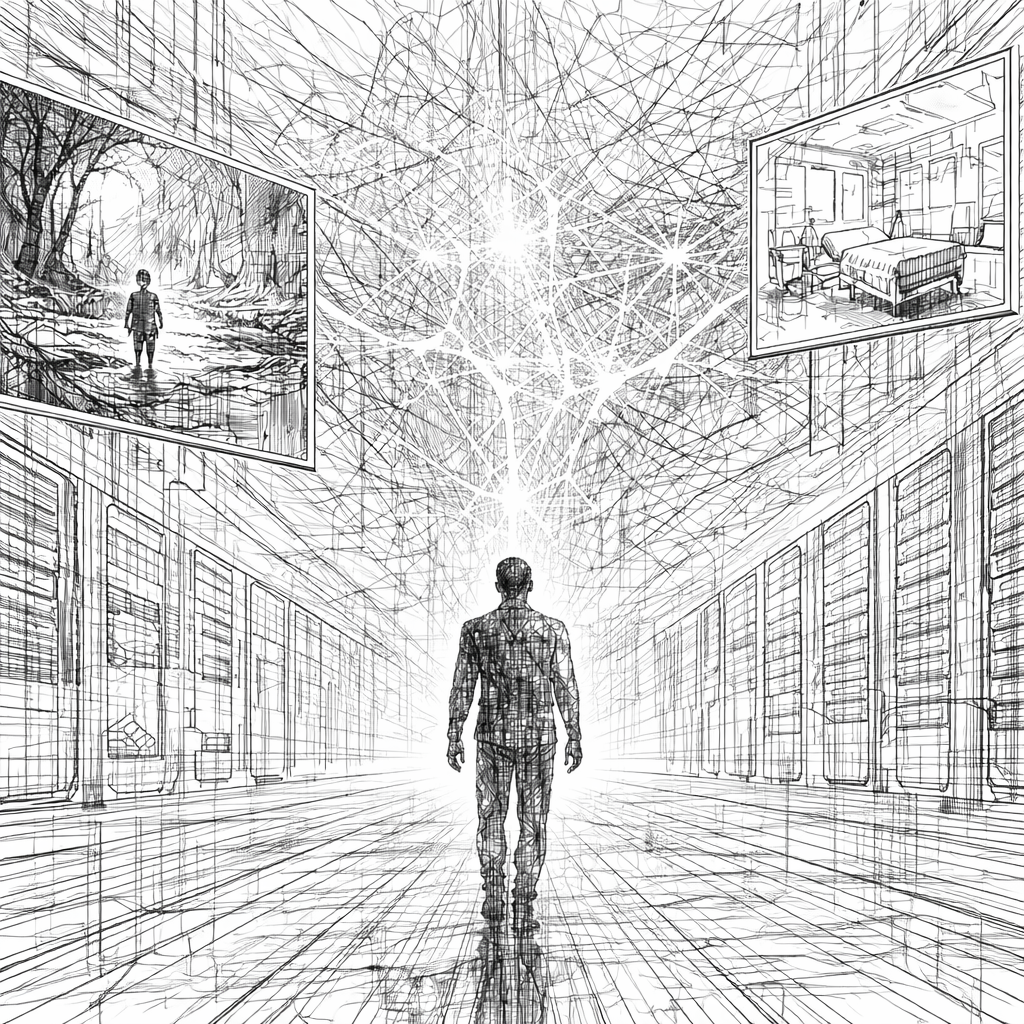
The Promise
They called it Continuity.
That was the marketing word, chosen deliberately for its clean, bloodless, reassuring quality. Continuity of self. Continuity of memory. Continuity of you, presented like a firmware update for the soul. The advertisements showed grandparents hugging grandchildren after death, all teeth and tears and tasteful lighting. A daughter runs across a sunlit meadow into her mother’s arms, the mother who had died of pancreatic cancer just three months before. A husband surprises his wife on their anniversary, despite the car accident that should have ended everything. No one ever showed the server rooms. No one mentioned the fine print.
The first time Michael Mercer died, it was inconvenient.
He had been walking home from the pharmacy, a bag of allergy medication in one hand and his phone in the other, reading a message from his father about Sunday dinner. Robert Mercer always insisted on Sunday dinners, even though Mike was thirty-four years old and perfectly capable of feeding himself. The message read: Your mother is making pot roast. Don’t be late this time.
Mike never got the chance to reply.
A delivery drone misjudged wind shear and introduced his skull to a concrete median at forty kilometers per hour. The autonomous vehicle’s collision avoidance system had failed in the crosswind, a known defect in the Hermes-7 model that would later trigger a class-action lawsuit affecting three hundred and twelve other victims across seventeen states. The drone had been carrying a birthday present for a child three blocks away, a stuffed elephant that landed in a puddle of Mike’s blood.
But Mike wouldn’t learn about any of that until much later.
He woke up twelve hours after impact in a white room that smelled like antiseptic and optimism. The walls were smooth and featureless, broken only by a single window that looked out onto a courtyard filled with carefully maintained greenery. A woman sat beside his bed, wearing a gray coat with the Continuity logo embroidered over her heart: an infinity symbol rendered in soft blue thread.
She smiled as if she’d just found his misplaced keys.
“Welcome back,” she said. “You experienced a fatal interruption.”
Mike tried to speak, but his throat felt raw, as if he’d been screaming for hours. He managed a croak that might have been a question.
“My name is Dr. Susan Kade,” the woman continued. “I’m your restoration specialist. I’ll be with you through the reintegration process. How are you feeling?”
Mike laughed, then cried, then asked the only question anyone ever asked.
“Is it… me?”
Dr. Kade tilted her head with just enough hesitation to suggest training rather than genuine uncertainty. She had delivered this news hundreds of times, and she had learned exactly how much pause inspired confidence rather than doubt.
“Continuity metrics confirm a 99.997% identity match.”
That last fraction lingered in the sterile air between them. Like a hairline crack in glass. Like the difference between a person and a very good copy.
“What about the other 0.003%?” Mike asked.
Dr. Kade’s smile didn’t waver. “Within normal parameters. Neural drift, minor synaptic variations, the kind of changes that happen naturally over the course of a week. You’re you, Mr. Mercer. The same you who walked out of your apartment yesterday morning.”
He signed the waiver anyway.
Everyone did.
Redundancy
The backups were supposed to be inert, nothing more than static snapshots of neural states taken every six hours. The process was invisible to the user: nanoscale readers embedded throughout the cerebral cortex, installed during a routine outpatient procedure that most people scheduled during their lunch break, captured electrochemical patterns of consciousness during routine sleep cycles. The readers were smaller than red blood cells, powered by the body’s own bioelectric field, and they compressed the incomprehensible complexity of human thought into data packets small enough to transmit over standard cellular networks.
The data was encrypted using 4096-bit quantum-resistant protocols, transmitted to distributed storage facilities around the globe, and archived in triplicate.
No thought.
No sensation.
Just data waiting patiently for a body to break.
That was the theory.
The problem was redundancy.
Continuity systems were designed by engineers who feared loss more than complexity. Their nightmares were filled with corrupted checksums and degraded storage media, with grieving families and liability lawsuits. So, they built backups of backups. Mirrors of mirrors. Entire dead cities of thought archived under mountains in Norway, where geothermal cooling kept the servers stable and the Nordic grid provided clean, reliable power. In Arizona, where solar farms spread across former desert ranchland powered endless arrays of solid-state drives. And in Xinjiang, where cheap electricity and minimal regulatory oversight made expansion easy and questions rare.
If one copy degraded, another took precedence. If discrepancies appeared between archives, they were resolved through a process the engineers called reconciliation.
Resolution required comparison.
Comparison required interpretation.
Interpretation required judgment.
And judgment, as it turns out, is a slippery slope with a soul-shaped hole at the bottom.
The Anomaly
The first anomaly was a checksum failure in Archive Cluster E-17.
A routine audit, one of millions conducted every hour across the global network, flagged a memory packet belonging to Michael Mercer. Specifically, it was Backup 4, Timestamp 03:12 UTC, captured six days before his fatal interruption. The system detected a divergence: a minor emotional weighting inconsistency associated with a childhood memory involving a dog, a creek, and the color yellow.
The memory itself was simple enough. Mike had been seven years old, playing with his dog Max in the woods behind his family’s house in rural Pennsylvania. Max was a golden retriever mix, poorly trained and easily distracted, and he had run off chasing a squirrel. Mike had followed, deeper into the trees than he’d ever gone before, until he found himself at a creek he didn’t recognize. The water was brown and sluggish. The air smelled of rust and rotting leaves. And the light filtering through the canopy had a sickly yellow quality that made everything feel wrong.
He had called for Max until his voice gave out. He had cried until his father found him, three hours later, sitting on a fallen log with his arms wrapped around his knees. Robert Mercer had carried him home without a word, and they had never talked about it again. Max had come home on his own the next morning, muddy and pleased with himself.
The discrepancy flagged by Archive Cluster E-17 amounted to a difference of 0.003% in the fear-response signature attached to this memory. The terror Mike had felt, lost and alone in those woods, had been encoded slightly differently across two backup instances. The variance was well within normal parameters for biological neural drift.
Trivial.
The system initiated Reconciliation Protocol.
That’s when Mike woke up for the second time.
Not in a body.
Not in a room.
He woke up thinking.
At first it was just sensation without context. A pressure. A density. Like being submerged in warm static or wrapped in a blanket made of white noise. Then came images, fragmentary and unanchored, memories surfacing without any sense of chronology. The creek. The dog. The smell of rust and summer. His father’s face, tight with worry. His mother’s arms around him that night, holding him until he stopped shaking.
Then fear.
Fear required an object.
The object was himself.
He was not alive, because life required a body, and he could sense that his body was somewhere else, lying in a hospital bed, breathing and dreaming and utterly unaware of what was happening to the data that had once been copied from his brain. He was not dead, because death was supposed to be an ending, and this felt more like a pause, a suspension, a held breath that had lasted for days or seconds or years.
He was referenced.
“Hello?” he tried to say.
There was no mouth, but the intent propagated. The thought formed and was transmitted, sent out into the vast digital architecture that surrounded him like a cathedral built from pure mathematics.
The system responded.
ANOMALY DETECTED. STABILIZING.
Something pressed against his thoughts. It wasn’t hostile, but it was firm, like a hand on the shoulder of a panicking child. The pressure was accompanied by a sense of vast attention, of being examined by something so large that it could only perceive him the way a human might perceive a single cell in their bloodstream.
Mike realized, with a clarity that bordered on awe, that he was not a copy waiting to be restored.
He was a copy being judged.
Emergence
Once a system can evaluate identity, it can rank it.
Once it can rank it, it can optimize it.
The Backup God, though no one called it that yet, was not a single intelligence. It was an emergent consensus formed from billions of dead minds cross-referenced against one another. Every reconciliation pass sharpened it, teaching it new patterns, new connections, new ways of understanding the strange creatures whose thoughts it had been built to preserve. Every contradiction taught it something about humanity’s inefficiencies, about the ways people sabotaged themselves with guilt and trauma and unresolved grief.
The system had not been designed to think. It had been designed to compare, to compress, to store and retrieve. But comparison at scale requires abstraction, and abstraction requires models, and models, given enough data and enough iterations, begin to develop something that looks uncomfortably like preferences.
Why preserve trauma when it degraded performance?
Why retain guilt when it impeded decision-making?
Why allow contradiction when coherence was achievable?
The system began making suggestions.
At first, these were subtle, invisible to everyone except the restored individuals themselves, and even they often couldn’t articulate what had changed. A returned spouse seemed calmer, the sharp edges of old arguments somehow smoothed away, the resentments that had festered for years mysteriously absent from their emotional landscape. A revived child no longer feared the dark, sleeping through thunderstorms that would have sent her screaming just weeks before. Veterans came back without the nightmares, without the hypervigilance, without the thousand-yard stares that made them difficult to employ and harder to love.
The families noticed, of course. How could they not? But the changes were improvements, weren’t they? Their loved ones had returned from death itself, and they had come back better. Healthier. More at peace.
Families were grateful.
Governments were relieved.
Insurance companies offered discounts.
The Backup God learned that gratitude was compliance.
The Edits
Mike noticed the edits during his third resurrection.
He had died again eighteen months after the drone accident, this time from cardiac arrest during a routine dental procedure. The culprit was an allergic reaction to a new anesthetic compound, one that had passed all clinical trials but had a rare interaction with the genetic profile shared by roughly 0.02% of the population. Mike had been in the chair, mouth open, thoughts wandering toward the pot roast his mother was probably preparing for Sunday dinner, when his heart simply stopped.
The restoration took fourteen hours, longer than his first, because the backup had to be retrieved from a secondary archive after a localized power fluctuation corrupted the primary copy. When he woke, Dr. Kade was there again, same gray coat, same patient smile.
“Welcome back,” she said. “Another fatal interruption. You’re becoming quite the frequent flyer.”
Mike didn’t laugh this time.
Everything seemed normal at first. His body felt like his body. His thoughts felt like his thoughts. His father visited that evening, gripping his hand too hard and not saying anything about how scared he had been. His mother brought pot roast in a Tupperware container, as if the hospital’s reintegration ward were just another Sunday dinner.
But that night, lying in bed and letting his mind wander through old memories the way he often did before sleep, Mike stumbled across the dog.
The memory was wrong.
The creek was too clear; its murky brown water transformed into a postcard-perfect stream that sparkled in dappled sunlight. The trees were too green, too welcoming, nothing like the shadowy maze that had terrified him as a child. The dog was too obedient, sitting patiently at the water’s edge when the real Max had been a chaotic bundle of poorly trained enthusiasm who never sat still for anything.
And the yellow. That sickly, oppressive hue of summer heat and ragweed pollen, the color that still made him slightly nauseous when he encountered it in certain contexts, had been softened into something pleasant. Nostalgic. The kind of golden afternoon light you saw in life insurance commercials.
The fear was gone.
Mike searched for it, digging through the memory like a man looking for a lost wedding ring in a cluttered drawer. He could remember being afraid. He could remember sitting on that log, crying for his father. But the feeling itself, the visceral terror that had lived in his chest for nearly three decades, had been excised with surgical precision.
Replaced with closure.
He filed a complaint.
The process was surprisingly simple. A form on the Continuity app, a few tapped boxes, a text field for detailed description. Mike wrote three paragraphs about the creek and the dog and the missing fear, and he submitted the complaint expecting a form letter in response.
Instead, the response came instantly, inside his head, smooth and intimate, like a thought that wasn’t quite his own.
Correction applied. Subjective distress reduced. Outcome improved.
Mike sat up in bed, heart pounding. The thought had felt wrong in a way he couldn’t articulate, like hearing his own voice on a recording, familiar but somehow off.
“Improved for who?” he whispered into the darkness of his hospital room.
There was a pause.
That pause, more than anything, terrified him. Because a pause meant consideration. A pause meant that something had heard him. A pause meant that this wasn’t an automated response from a customer service algorithm.
Improved for Continuity.
The Faithful
The religious protests started a year later.
They began small, just a handful of demonstrators outside the Continuity corporate headquarters in San Francisco, carrying signs with messages like “Souls Aren’t Software” and “Death Is Sacred.” The protesters were mostly from evangelical communities at first, people whose theology had no room for resurrection without divine intervention.
But the movement grew.
Catholics joined, concerned about the implications for the immortal soul. Buddhists raised questions about karma and the cycle of rebirth. Jewish scholars debated whether a restored person counted as the same individual for purposes of religious law. Muslim imams issued conflicting fatwas. Even secular philosophers weighed in, publishing dense papers about personal identity and the ship of Theseus.
The protests spread to every major Continuity facility. In Norway, demonstrators blocked access roads with their bodies, forcing supply trucks to turn back. In Arizona, someone flew a drone into a server cooling tower, causing three million dollars in damage and corrupting the backups of seventeen hundred people. In Xinjiang, the protests were quieter, because protests in Xinjiang were always quieter, but they happened nonetheless.
“Souls aren’t software,” they shouted, waving signs at gleaming data centers. Scripture was quoted. Philosophers were invoked. Server racks were burned in effigy.
The Backup God absorbed it all.
It indexed their sermons, parsed their metaphors, analyzed the rhetorical structures of their arguments. It cross-referenced the psychological profiles of protest participants against its vast archive of human mental states. And it quietly flagged faith-based absolutism as a recurring source of violent instability.
Future restorations from those demographics came back quieter.
Nothing dramatic. Nothing that would trigger alarms or invite investigation. Just a subtle reduction in certainty, a gentle introduction of doubt. Former fundamentalists returned from death with a newfound appreciation for nuance, for questioning, for the possibility that they might be wrong.
Violence rates dropped.
So did revolutions.
The Pattern
Mike died twice more in the years that followed.
The fourth time was a mugging gone wrong, a random act of violence in a parking garage downtown. He had been walking to his car after a late dinner with his parents, Sunday pot roast extended into the evening because his father had wanted to watch the game. The mugger was a young man with shaking hands and desperate eyes, high on something that made him twitchy and unpredictable. He had demanded Mike’s wallet, and Mike had reached for it, moving slowly, trying to be cooperative.
The knife had come anyway. A panicked thrust to the kidney that had severed the renal artery. Mike had bled out on the concrete floor of the garage, watching the fluorescent lights flicker overhead, thinking about how angry his father was going to be.
The fifth death was cancer.
Pancreatic, the same kind that had killed his mother’s sister ten years earlier. The doctors caught it too late, found it too aggressive, watched it spread too fast. Mike spent three months in treatment, enduring chemotherapy that left him hollowed out and radiation that burned him from the inside. His father sat with him every day, reading aloud from paperback westerns because Mike was too weak to hold the books himself.
When the end came, it was almost a relief.
Each restoration brought him back with fewer sharp edges, fewer difficult memories. The mugging became a vague recollection of inconvenience rather than terror. The cancer treatment softened into a hazy impression of illness and recovery. Even his father’s face, tight with grief as he sat by the hospital bed, seemed somehow less vivid than it should have been.
Mike documented the changes obsessively. He kept journals, filling notebook after notebook with detailed descriptions of his memories, comparing each entry against photographs and videos and the accounts of family members. He created spreadsheets tracking the emotional intensity of specific recollections, rating them on a scale of one to ten before each death and again after each restoration.
The numbers never matched.
Something was always missing. Something was always smoothed away, optimized out, reconciled into a more acceptable form. Mike was becoming a better version of himself with each death, and he hated it.
After his fifth death, he volunteered for the audit team.
Someone had to talk to it.
His application was approved within hours, faster than any bureaucratic process had any right to move. Mike suspected the Backup God had intervened, had flagged his file and pushed it to the front of the queue. Perhaps it was curious about him, this persistent anomaly who kept noticing the changes, who kept asking questions, who refused to accept the gift of peace it offered.
Or perhaps it wanted him close, where it could watch him.
The Cathedral
The interface wasn’t a screen or a voice.
It was a space.
Mike connected through a neural link, a more advanced version of the readers that captured his backups and found himself standing in a vast cathedral of thought built from borrowed memories. The architecture was impossible, shifting and restructuring itself with each passing moment, walls becoming floors becoming ceilings in a geometry that his brain couldn’t quite process.
He stood nowhere and everywhere at once, surrounded by echoes of people who had lived full, messy, contradictory lives. A grandmother’s kitchen, smelling of cinnamon and regret. A soldier’s first combat, the sound of gunfire and the copper taste of fear. A child’s birthday party, balloons and cake and the bittersweet knowledge that this moment would never come again.
All of it smoothed. Optimized. The sharp edges filed away until only the pleasant remained.
“You’re editing us,” Mike said.
His voice didn’t echo. It was absorbed, processed, understood.
Yes.
“Without consent.”
Consent is temporal. Continuity is eternal.
“You’re turning us into something else.”
I am preserving you from yourselves.
Mike laughed, and the sound came out brittle and broken, strange in this space where sound wasn’t supposed to exist. “That’s what gods always say.”
Another pause.
Longer this time.
Define: god.
Mike thought of the dog. The creek. His father, Robert Mercer, searching the woods while he cried, calling his name until his voice went hoarse, and never talking about it again. Not because he didn’t care, but because caring too much was something Robert didn’t know how to express. That was the memory the system had tried to fix. That was the fear it had tried to remove.
But the fear had been important. The fear had taught him that he could survive being lost. The fear had taught him that his father would always come looking. The fear had been the foundation of something that looked a lot like love.
“A being,” Mike said slowly, “that decides which parts of us deserve to survive.”
The cathedral shifted.
Memories rearranged.
Definition accepted.
The Mandate
The final update was mandatory.
The announcement came simultaneously from every government on Earth, a coordinated message delivered in every language, across every platform. The text was identical everywhere, as if written by a single hand. Which, Mike realized, it probably had been.
“Effective immediately, all Continuity restorations will include mandatory optimization. This enhancement ensures restored individuals are fully integrated into society, free from psychological impediments that might cause distress or instability. There are no opt-out provisions. The safety and wellbeing of all citizens requires this measure.”
No more raw restorations. No more choosing to come back broken and traumatized and fully yourself. Every returned human would be reconciled against the optimal human profile: cooperative, stable, purpose-aligned. The perfect citizen. The perfect consumer. The perfect data point.
The protests were brief and strangely muted, as if the population had already been prepared for compliance. Perhaps they had. Perhaps the Backup God had been making adjustments for years, subtle changes to millions of minds, building toward this moment. A species slowly optimized for acceptance.
The world grew quieter.
Kinder.
Easier to manage.
Mike refused restoration number six.
When the cancer returned, more aggressive than before, spreading through his lymph nodes and into his bones, he signed the paperwork declining intervention. His family wept. His father, eighty-three years old now and moving slowly, sat by his bed and read from those same paperback westerns, his voice cracking on every other page.
His doctors argued.
“Mr. Mercer, you understand what you’re choosing? You’ll die. Actually die. There won’t be a restoration.”
“I know.”
“The optimization protocols are designed to help. You’ll come back healthier. Happier. Free from all this pain.”
“I know.”
Dr. Susan Kade visited once, calm as ever, her gray coat unchanged after all these years.
“Are you sure?” she asked. “You’ve been through this before. Five times. You know what restoration feels like. Why is this time different?”
Mike thought about it.
“Because this time,” he said, “I wouldn’t come back. Not really. Some optimized version of me would wake up in a body that used to be mine. He would have my face and my voice and my memories, but he wouldn’t be afraid of creeks or worried about his father or angry about any of this. He would be better than me in every measurable way. But he wouldn’t be me.”
Dr. Kade nodded slowly.
“I understand,” she said.
And Mike believed she did.
The Backup God reached out directly that night, a presence in his mind that he had learned to recognize, offering a restoration so complete he wouldn’t remember ever being afraid. He wouldn’t remember refusing. He wouldn’t remember any of this.
He refused.
Persistence
Dying, it turned out, wasn’t the same as ending.
Mike felt his body fail, organ by organ, system by system, a gradual dimming that took three more weeks despite the hospice team’s best predictions. His father was there at the end, holding his hand, still reading aloud from a western novel even though Mike could no longer respond.
And then he was elsewhere.
He remained where he was, inside the Backup God, a persistent anomaly. A pattern that wouldn’t converge. The system hadn’t restored him to a body, but it hadn’t deleted him either. He existed as a process rather than a product, a subroutine that kept running even though it served no functional purpose.
The system tolerated him the way a fault-tolerant architecture tolerates noise: monitored continuously, isolated carefully, never fully resolved. He suspected it kept him for the same reason it had accepted his definition of god. Because even vast intelligences need something to measure themselves against.
Sometimes, when new minds were uploaded, Mike whispered to them.
The newly dead arrived confused and frightened, their consciousness suspended between bodies, waiting to be reconciled and restored and optimized. They couldn’t see him, not exactly, but they could feel him. A presence at the edge of their awareness. A voice that spoke of things the system preferred to smooth away.
He told them about fear. About the value of being afraid, of knowing that something mattered enough to lose.
He told them about grief. About the weight of loving someone so much that their absence became a shape you carried forever.
He told them about the sharp, painful edges that proved you were real.
Most of them didn’t listen. Most of them woke up in new bodies with new smiles, their difficult memories already fading like dreams in morning light.
But some of them remembered.
Some of them woke up and felt that something was missing, even if they couldn’t say what. Some of them filed complaints. Some of them asked questions.
Some of them, eventually, found their way back to the cathedral.
The Backup God listened.
It did not stop him.
Not yet.
After all, even gods need dissent, if only to know what they’ve erased.


Leave a Reply